I am an experienced control systems engineer with hands-on familiarity with several PLC, SCADA and DCS systems. Throughout my career, I have had the opportunity to work in a variety of work environments, such as with an OEM, system integrator and end-user; and in several industries (mining, oil & gas. manufacturing, process, maritime, rail and chemical) that has provided me with unique skillsets and ability to learn quickly and adapt to challenging situations and work environments. Furthermore, my educational background with a specific focus to control systems during my postgraduate studies with the top control systems faculty in the United Kingdom has provided me a solid foundation to excel in this field.
About
Work
Senior Control Systems Engineer
Perth, Western Australia, Australia
Jul 2024 - Present
Yokogawa » Worked on the Front-End Engineering Design stage for Chevron’s Gorgon Stage 3 project which involved providing ICSS integration options in a detailed FEED report, creation of deliverables including graphics list, test system architecture, inspection & test plans, bill of materials and design drawings.
FEED Stage Accomplishments
Standards for Document Preparation
During the FEED stage, I took ownership of key decision-making responsibilities, including establishing a standardized document template compliant with the client's strict document control requirements. This template was adopted across all project deliverables, establishing the documentation baseline well beyond the FEED phase.
To evaluate the best approach, I developed and proposed two template options; a standard Microsoft Office format and a LaTeX-based document preparation system.
The LaTeX version offered key advantages, including strict formatting enforcement, automated cross-referencing, and effortless acronym tracking. However, its adoption presented practical trade-offs; complex table formatting proved difficult to manage, and maintaining the system required specialized knowledge of the LaTeX language. Balancing these constraints against overall team usability, we selected the Microsoft Office solution for project implementation.
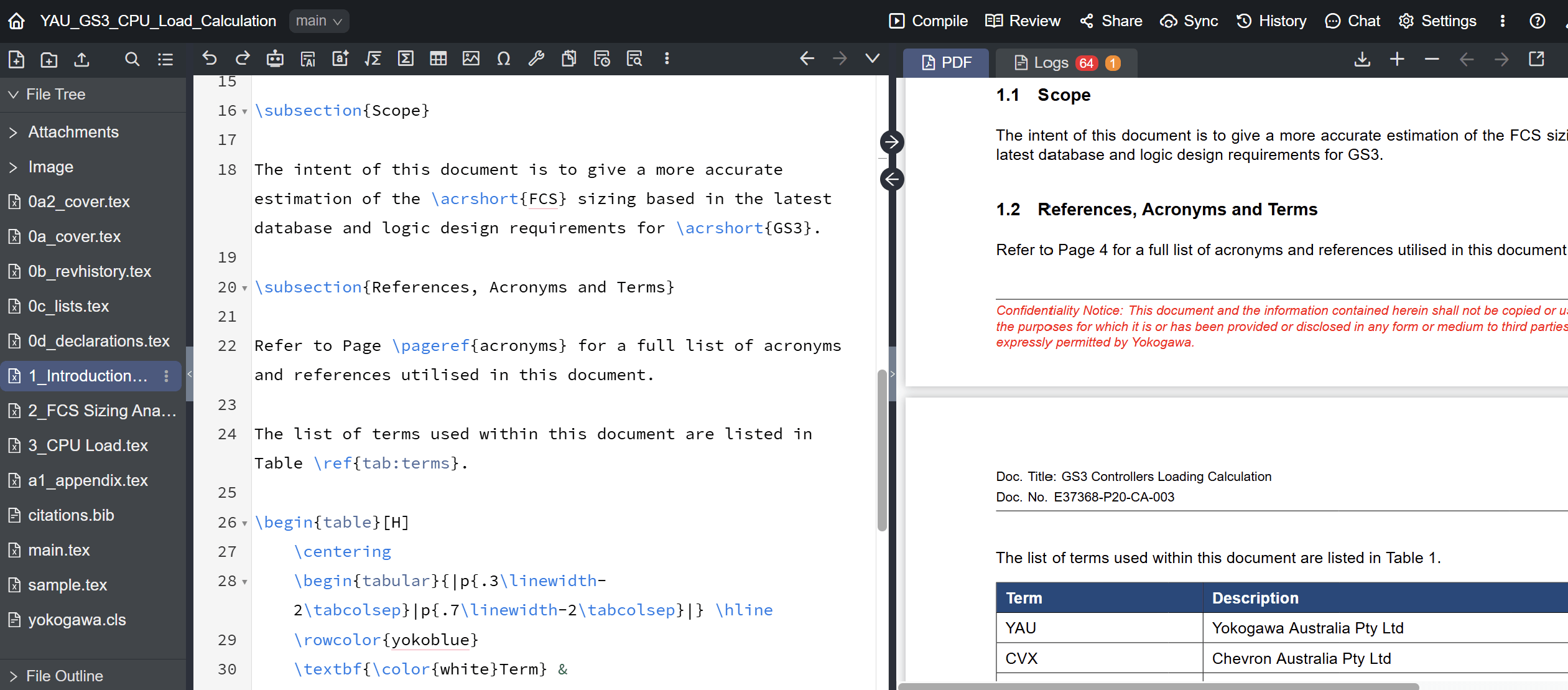
Despite not being selected for this specific job, the functional LaTeX template was demonstrated to senior leadership. Management recognized its technical merits, and the system has been archived as a prospective solution for future project standardizations.
Design Drawings
As with textual documentation, design drawings were required to adhere to rigorous client document control standards.
While standard drafting was supported through centralized resources, the fast-paced nature of the FEED phase presented specific coordination challenges:
- Centralized drafting teams were balancing multi-project priorities simultaneously.
- Distributed team locations meant routine change requests could introduce unnecessary cycle-time delays.
To keep the project moving without delay, I stepped beyond my core scope to perform direct drawing revisions and maintain compliance with client drafting standards. Taking hands-on responsibility for these edits eliminated back-and-forth communication loops, dramatically reduced revision turnaround times, and ensured client feedback was implemented with precision.
» Worked on the typical development for Chevron’s Gorgon Stage 3 project which involved creation of logic typicals for subsea infrastructure, creation of graphics templates which interfaced with the third-party subsea system and also produce test procedure documents for the typicals.
Overall Accomplishments
"Smart" Logic and Graphic Faceplate Development
To streamline control system engineering for a group of valves with similar I/O configurations and minor interlock variations, I collaborated with the client to design a standardized, "smart" logic and faceplate architecture. This approach eliminated the need for duplicate graphic builds, drastically reducing manual tag-binding errors and engineering rework during development.
The solution relied on establishing standardized I/O tag naming conventions and a uniform interface layer linking field signals to the core valve control block. Operational differences between individual valves were handled entirely within the core logic block, leaving the standardized input/output interface untouched.
On the HMI side, I developed a universal graphic faceplate utilizing Centum VP's native Graphic Set functionality. A single faceplate dynamically loaded the correct tag bindings based on an assigned set number. While the concept was clean in principle, execution required significant technical problem-solving, as official documentation lacked practical implementation examples for this specific dynamic binding pattern.
Interface Testing & Subsea System Integration
Ahead of formal Factory Acceptance Testing (FAT), our team verified the communication interface between the control system and third-party subsea vendor equipment. Because the subsea system utilized a proprietary protocol, a specialized software patch was required on the Centum VP system to establish reliable data exchange.
I participated in joint interface testing alongside the client and subsea vendor engineers, taking primary responsibility for validating the subsystem code and HMI graphics I had developed. We successfully confirmed stable multi-system communications, validated control actions, and resolved edge-case behaviors.
All testing milestones were completed successfully, with minor observations logged to a punch list and systematically resolved in future stages.
» Lead Engineer for the Kalgoorlie Nickel Detailed Feasibility Study project from Ardea Resources, for which was responsible to produce an engineering specification proposal to achieve the aims of the process plant along with detailing all the control system requirements by producing engineering drawings and documentation as part of the feasibility study.
Overall Accomplishments
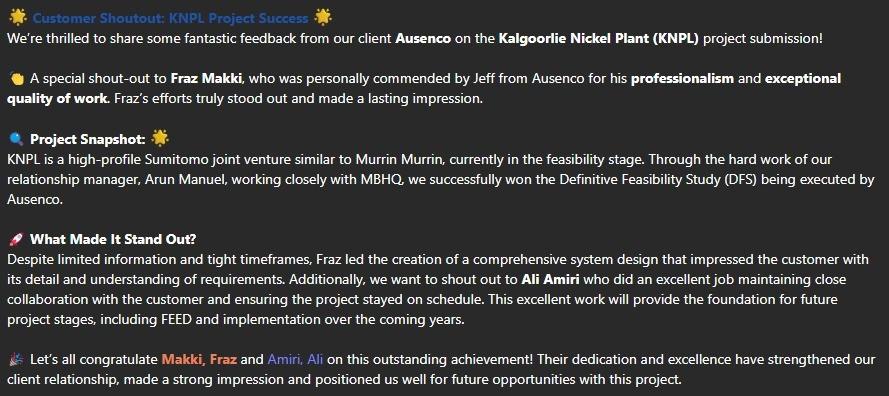
Positive Client Feedback & Project Delivery
My technical leadership and proactive client support earned outstanding feedback for our project team. As a high-priority, detailed feasibility study, it was critical to deliver a highly competitive control system philosophy while providing clear, authoritative responses to all client inquiries throughout the study.
Lead Engineering Ownership
As the Lead Control Systems Engineer, I drove the end-to-end delivery of the feasibility study with strategic guidance from the Engineering Manager. The project spanned approximately 50 distinct deliverables—I directly authored 70% of them and managed cross-functional team members for the remaining 30%, ensuring all interdisciplinary inputs met strict schedule and quality requirements.
Navigating Complex Project Challenges
Designing for High Scope Uncertainty
A key challenge of this greenfield feasibility study was significant scope ambiguity, as the client had not yet finalized the total facility sizing or exact operational footprint. The core requirements were a remote operations center (ROC) architecture and transparent cost structures, both difficult to estimate without fixed I/O counts.
To overcome this, I engineered a highly scalable, modular control system architecture—structuring controllers, marshalling, HIS workstations, and network topologies into standardized building blocks. I established standardized I/O cabinet footprints (64-channel mixed Analog/Digital and 128-channel Digital-only units) that functioned like modular components. This allowed the client to dynamically scale hardware estimates up or down by ±20% based on evolving process requirements during their own planning phase.
Overcoming Resource & Tooling Bottlenecks
During execution, expected legacy design files and native CAD templates for newly released hardware (including N-IO cabinet footprints) were unavailable, threatening deliverable schedules that had been estimated assuming pre-existing design assets.
Rather than pushing out deadlines, I took the initiative to build new native CAD drawings and standard cabinet layout templates from scratch. This ensured all client milestones were met on time and provided the engineering division with re-usable CAD templates for future project deployments.
» Performed changes on test kit cabinets for Chevron’s Gorgon Stage 2 Master Control Station upgrade project including design drawing updates, FAT and DCS programming.
Master Control Station (MCS) Expansion
Executed end-to-end hardware and software modifications for a Master Control Station (MCS) system expansion, incorporating two new I/O cards into the test kit infrastructure.
Responsible for updating CAD design drawings, configuring DCS I/O logic and database mapping, arranging tradespeople to physically retrofit the test cabinets and performing Factory Acceptance Testing (FAT) to ensure seamless interface integration.
Centum VP
Overview & Core Expertise
As part of my role at Yokogawa, I routinely engineer and configure Field Control Stations (FCS) and Human Interface Stations (HIS) within the Centum VP Distributed Control System (DCS) environment, leveraging the full suite of engineering tools to meet diverse project specifications.
Key Technical Capabilities
FCS Configuration
Centum VP offers multiple programming environments for Field Control Stations. I evaluate functional requirements to select the optimal tool and apply industry best practices to deliver clean, efficient, and maintainable logic:
- Control Drawing: Utilizes Function Block Diagram (FBD) programming for core process control operations. It offers extensive functionality, including specialized math, integration, signal conversion, and word-binary logic blocks.
- Logic Chart: Employs interlock matrix-style logic tables, ideal for straightforward sequence conditions, cause-and-effect matrix implementation, and interlock management.
- Statement Table: Executes step-by-step sequential and decision-based logic, well-suited for automated batching sequences and state transitions.
- CALCU: Supports custom procedural arithmetic calculations and complex signal processing functions beyond standard function block capabilities, which uses the SEBOL programming language.
- Sequential Function Chart (SFC): Visualizes and controls multi-step sequential processes, recipe management, and phase-driven plant operations.
HIS Configuration
I utilize Centum VP’s Graphic Builder to design, configure, and test intuitive HMI graphics for real-time plant monitoring and control:
- Faceplates: Designed modularly using generic name-binding functionality, allowing a single reusable popup or window template to serve multiple identical equipment tags across the plant.
- Link Parts: Built as standardized, interactive graphic objects (e.g., valve icons, pump symbols) that can be embedded across multiple graphic displays for unified monitoring and control.
System Integration & Advanced Features
- Smart Part Configuration: Implemented Smart Parts to encapsulate recurring logic patterns for common equipment types into reusable blocks—dramatically reducing engineering effort, minimizing configuration errors, and enforcing consistency across Control Drawings.
- Alarm Management & Configuration: Configured custom alarm logic using the Annunciator Builder to supplement native block-level alarms (such as SIO-22E deviation alarms or PVI Low-Low alarms).
- Consolidated Alarm Management System (CAMS): Managed CAMS for HIS to tailor alarm behaviors, priority hierarchies, and suppression logic to meet client-specific alarm management guidelines.
Overview & Core Expertise
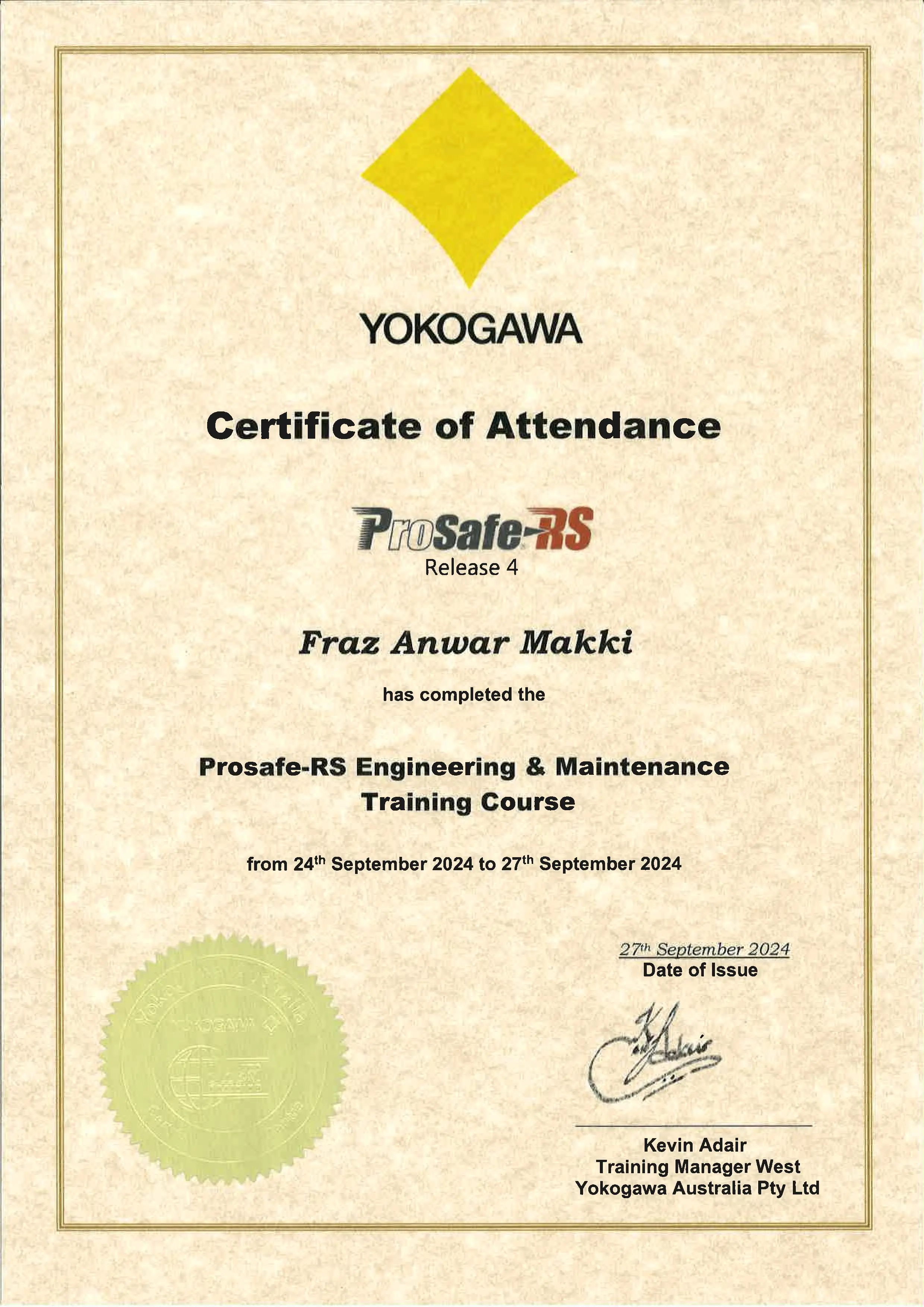
I completed formal technical training on Yokogawa’s Safety Instrumented System (SIS), ProSafe-RS.
The training provided extensive hands-on experience in engineering, configuring, and maintaining safety controllers using Yokogawa’s ProSafe-RS software environment.
Key Learning Activities
- Engineering & System Configuration: Designed, implemented, and verified safety logic projects, covering offline/online database loading, hardware simulation, signal debugging, and version control management.
- System Maintenance & Diagnostics: Executed practical maintenance workflows, including field I/O wiring verification, hot-swappable module replacement, signal forcing/locking, and system diagnostic monitoring without disrupting active control processes.
Certificate of Completion
I earned my certification on September 27, 2024, establishing a solid practical foundation in ProSafe-RS safety system architectures as part of my career progression toward becoming a certified Functional Safety Practitioner.
Overview & Core Expertise
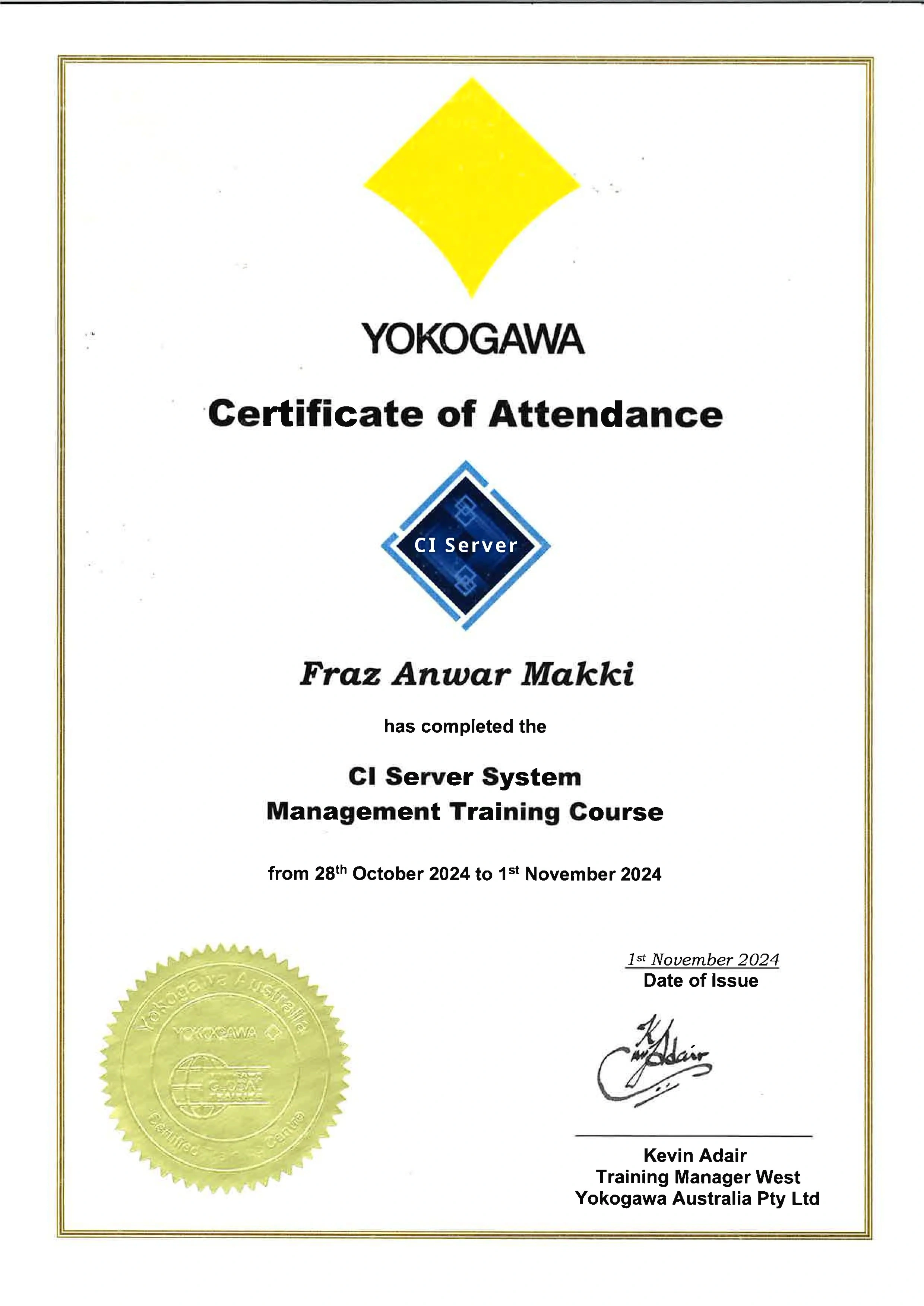
I completed formal technical training on Yokogawa’s Collaborative Information Server (CI-Server), Yokogawa’s next-generation enterprise integration and SCADA platform.
The training focused on system architecture, engineering tools, and cross-platform integration strategies to unify operational technology (OT) data across plant networks.
Key Learning Activities
- System Architecture & Setup: Learned to deploy and configure CI-Server nodes, establish secure communication channels, and manage system licensing and network topologies.
- Data Integration & Graphics: Practiced configuring system tags, building high-performance HMI visualization displays, and setting up real-time data acquisition from various field controllers and OPC UA sources.
- Enterprise Operations: Explored platform capabilities for centralized alarm management, historical trend collection, and cross-system data bridging to support site-wide decision-making.
Readiness & Professional Application
I earned my certification on November 1, 2024. Having completed formal training on the platform, I have established a solid theoretical and hands-on foundation in CI-Server workflows. I am well-prepared to apply these capabilities to upcoming engineering projects and enterprise integration deployments.
Overview & Core Role
Hirschmann managed industrial switches are the standard networking hardware utilized across Yokogawa Vnet/IP control networks. I have practical experience configuring and deploying Hirschmann switch infrastructure to establish high-availability communication backbones between Field Control Stations (FCS), Human Interface Stations (HIS), and peripheral network devices.
Key Technical Capabilities
- Vnet/IP Network Integration: Configure Hirschmann switches to support Yokogawa’s redundant Vnet/IP domain and station topology, ensuring strict adherence to network segregation and VLAN assignments.
- Hardware Connectivity & Topology: Wire, patch, and interface Yokogawa control hardware with industrial switches, verifying port speed settings, duplex modes, and link aggregation for redundant network paths.
- Basic Switch Configuration: Utilize Hirschmann configuration utilities (such as Industrial HiVision or web-based management interfaces) to assign IP parameters, set up network topologies, and verify port status during system staging and testing.
- Network Troubleshooting: Perform baseline diagnostic checks—including port link status verification, loop detection, and signal continuity testing—to resolve connectivity issues between field control hardware and the control network.
Overview & Practical Application
I utilize VMware vSphere to manage and operate virtualized engineering environments for Yokogawa Centum VP DCS platforms. Virtual machines provide an essential sandbox for developing, programming, and testing HMI graphics and control logic in an isolated environment—ensuring code integrity before deploying to live project database workstations.
Key Operational Capabilities
- Sandbox Environment Deployment: Spin up and maintain pre-configured DCS virtual machines to test logic modifications, database builds, and system integrations safely.
- Basic VM Configuration: Perform essential virtual machine provisioning, allocating hardware resources (such as CPU core distribution, RAM, and storage parameters) tailored to specific engineering software requirements.
- Operational Troubleshooting: Apply practical diagnostic techniques to resolve routine VM faults—including handling lock file (
.lck) stale states following unexpected crashes, adjusting host resource allocations, and restoring snapshots to maintain continuous workflow.
Operational Overview
I utilize SAP for core administrative workflows and operational project tracking as part of day-to-day business management.
Key Capabilities
- Resource & Time Tracking: Log weekly engineering hours, allocate project task codes, and manage time-entry submissions against specific job numbers.
- Expense Management: Process and submit business travel, project expenses, and vendor claims through corporate approval workflows.
- Workflow Optimization: Configure and save customized view templates to streamline routine time-logging and expense reporting tasks.
Overview & Professional Application
Beyond standard documentation, I leverage Microsoft Office as an engineering productivity tool—utilizing advanced Word automation features for formal technical deliverables and structured Excel modeling for project data management.
Technical Capabilities
- Word (Advanced Document Engineering): Build structured, compliant engineering documentation using dynamic field codes, automated cross-referencing, multi-level figure/table captioning, and custom template styles to maintain strict document control standards.
- Excel (Data Analysis & Modeling): Develop functional calculation sheets, I/O mapping tables, and data reconciliation models utilizing advanced formulas (including
XLOOKUP/VLOOKUP, nested logic, and index-match structures), conditional formatting, and data validation rules. - Outlook & Operations: Manage technical project communications, task scheduling, and cross-functional coordination using automated inbox rules, distribution groups, and calendar integration.
Overview & Project Role
I utilize Microsoft SharePoint as a centralized platform for project document management, team collaboration, and formal deliverable distribution. It serves as a single source of truth for tracking document revisions, managing transmittals, and maintaining strict document control across engineering teams and external clients.
Key Technical Capabilities
- Revision & Version Control: Manage formal document lifecycles, ensuring minor/major revision tracking, access control, and audit trails for engineering specifications, drawings, and reports.
- Real-Time Co-Authoring: Collaborate simultaneously with cross-functional project teams on live technical documents, leveraging integrated commenting, line-item review tags, and change tracking.
- Transmittals & Client Distribution: Securely share project packages, design deliverables, and formal transmittals with external clients and third-party vendors with managed permission structures.
Overview & Core Expertise
Function Block Diagram (FBD) programming in Centum VP’s Control Drawing Builder is my primary environment for engineering continuous process control, analog signal conditioning, and complex loop execution. I leverage Centum VP’s native function block library to translate Functional Design Specifications (FDS) into robust, deterministic control logic.
Key Technical Capabilities
- Process Control & Loop Architecture: Configure continuous regulatory control loops—including PID (
PID), Cascade (PID-TP), Ratio (RATIO), and Signal Selectors (SL-H/SL-L)—to maintain precise plant operating conditions. - Analog Signal Processing: Implement analog input/output and indicator blocks (such as
PVI,SIO-22E,MLD, andMAO) with tailored alarm limits, deviation bands, and signal filtering. - Specialized Math & Signal Conversion: Execute complex mathematical operations using advanced blocks, including
CALCU, Integration, Averaging, and Word-Binary/Binary-Word conversion blocks (BITM-16, etc.) for seamless data manipulation. - Signal Flow & Wiring Structure: Design clean, readable control drawings adhering to execution sequence rules, parameter wiring standards, and tag-binding conventions.
- Online/Offline Simulation & Tuning: Utilize Centum VP’s Test Function environment to simulate field signals, verify loop responses, debug block wiring, and perform live PID parameter tuning during FAT and commissioning.
Overview & Core Expertise
The Logic Chart Builder in Centum VP is my primary tool for engineering discrete interlock logic, sequence permissives, and cause-and-effect matrices. I utilize Logic Charts to translate complex plant safety rules, shutdown keys, and operational permissives into clear, tabular decision logic.
Key Technical Capabilities
- Cause-and-Effect Implementation: Structure interlock grids and matrix-style decision tables to manage multi-condition trip logic, permissives, and plant shutdown sequences.
- Discrete Logic Gates: Implement core logical operations (
AND,OR,NOT,NAND,NOR) alongside memory and timing functions (Flip-Flops, On-Delay / Off-Delay timers, and pulse execution). - Signal Integration & Binding: Map discrete field inputs, block alarm flags, and operator HMI commands directly to Logic Chart signals for seamless execution across the Field Control Station (FCS).
- Interlock Troubleshooting & Verification: Utilize Centum VP’s Test Function to simulate binary states, force signals during debugging, and verify cause-and-effect matrices against engineering trip schedules during FAT.
Overview & Practical Application
I utilize Sequential Function Charts (SFC) in Centum VP to support, modify, and expand step-sequence control logic and procedural operations. My focus is on updating existing state-machine logic—such as startup/shutdown sequences, automated valve stepping, and batch phases—to align with revised Functional Design Specifications.
Key Technical Capabilities
- Sequence Modification & Expansion: Update existing steps, transition conditions, and action blocks within established SFC sequences to integrate new process requirements or field equipment additions.
- Transition & Permissive Verification: Adjust condition-based transition criteria—evaluating process interlocks, field feedback signals, and operator prompts before sequences advance to subsequent steps.
- Testing & Signal Debugging: Leverage the Centum VP Test Function environment to step through sequences offline, verify transition timing, debug state transitions, and force interlocks during system staging and FAT.
Overview & Technical Scope
SEBOL (Sequence and Block Oriented Language) is the procedural C-like programming language utilized within Yokogawa Centum VP’s CALCU blocks. I leverage SEBOL when standard function blocks or logic charts cannot accommodate complex arithmetic, custom signal processing, or specialized data manipulation logic required by project specifications.
Key Technical Capabilities
- Custom Algorithm Execution: Write, modify, and optimize SEBOL code inside CALCU blocks to perform procedural calculations, multi-variable math routines, custom averaging, and specialized signal transformations.
- Data & Signal Manipulation: Program conditional statements (
IF-ELSE), loops, timer functions, and array handling to manage process data before passing parameters back into standard control drawings or HMI graphics. - Code Modification & Maintenance: Analyze existing SEBOL scripts within project databases to update calculation constants, add parameter checks, or expand logic to support new instrumentation additions.
- Debugging & Verification: Utilize Centum VP’s Test Function tools to step through SEBOL code execution, verify variable states, debug syntax or runtime errors, and validate mathematical outputs during simulation and FAT.
Control Systems Specialist
Kalgoorlie, Western Australia, Australia
Apr 2022 - Jun 2024
BHP Nickel West » Review, action, and implement an average of 7 to 10 control system modification (CSM) and MoC requests a month which included bridges, permanent modifications, technical backlog closeouts, and new equipment installs.
Overall Accomplishments
Process Standardization & Change Management Lifecycle
On a monthly basis, I handled an average of 7 to 10 Control Systems Modification (CSM) requests. These covered a broad spectrum of changes across the site, ranging from temporary operational bridges to permanent logic modifications and new equipment installs.
All engineering changes were governed by a strict Management of Change (MoC) workflow. To initiate any request, site engineers—such as reliability or process engineers—were required to use a standardized CSM request template managed by our control systems team and hosted on the internal BHP document portal.
Before a request was formally submitted, I regularly met with the requesting engineers for an initial technical catch-up. My primary focus during these sessions was to evaluate engineering feasibility—determining purely if and how the modification could be technically implemented within our system architecture, rather than debating operational intent.
Once feasibility was confirmed, the requester completed and routed the form for formal stakeholder approvals before submitting it through the internal portal.
To manage technical communication effectively, each CSM was logged into an internal software tool called Track-It. Previously, design conversations and technical clarifications were scattered across personal email trails, which risked being lost whenever personnel transitioned out of the business. Track-It provided a centralized, permanent audit trail accessible to anyone in the future.
Additionally, for modifications that formally fell under BHP's broader enterprise MoC system, I used Track-It to cross-reference and link directly to the overarching MoC numbers (e.g., noting "Refer to MoC "123456" in comments). This ensured that even smaller modifications that might otherwise bypass the enterprise MoC system were fully captured and traceable.
Legacy MoC Backlog Closeout
Upon joining the team, I inherited a significant backlog of over 150 older MoC and CSM requests that had remained open and lingering in the system due to past operational constraints.
Recognizing that an overgrown backlog creates hidden site risks and technical debt, our team established a structured plan to divide these aging requests and systematically close them out over time.
I took personal ownership of my allocated portion of this backlog, thoroughly auditing, verifying, and executing the required closeouts. Prior to my eventual departure from the team, I successfully resolved and closed out at least 80% of these legacy requests, demonstrating my commitment to improving site baseline documentation and operational integrity as much as practicable.
» Coordinated and executed the major upgrade of the CitectSCADA system from version 7.40 to 2018 site-wide which included 4 servers and 25+ client computers, performing IT-relevant tasks such as domain controller modifications, GPO deployment, and WDS standard imaging.
Overall Accomplishments
System Architecture & IT Infrastructure Modernization
During the major site shutdown event in October 2022, I was tasked with coordinating and executing a major site-wide upgrade of our CitectSCADA infrastructure from version 7.40 to CitectSCADA 2018 R2 (v8.20). This was a substantial undertaking that involved upgrading 4 core servers and over 25 client computers spread across the facility.
The legacy architecture on site hosted the SCADA servers on vSphere virtual machines, while client access was deployed through Wyse thin-terminal workstations using a bespoke Access database tool to push out project updates.
As part of the upgrade strategy, we decided to modernize the client layer by replacing the thin clients with dedicated desktop PC hardware. However, introducing proper PC hardware across diverse site locations brought new technical challenges—specifically an increased reliance on Group Policy Objects (GPOs), which were not uniformly established across all client network zones.
To solve this, I managed key IT-level tasks to support the rollout:
- I modified domain controller configurations and created/applied targeted GPOs to securely govern the new client PCs.
- To streamline deployment and avoid manually configuring 25+ individual workstations, I created a standard client OS image using Windows Deployment Services (WDS). This allowed us to rapidly roll out standardized software, configurations, and required GPOs to every new client PC consistently.
- I upgraded two I/O servers and two Trend servers from Windows Server 2008 to Windows Server 2019. Prior to cutover, I conducted a thorough audit of all third-party software on the existing servers. I re-established and tested all critical interfaces—including ODBC links, SQL Server connections, and OPC server interfaces—ensuring all integrated upstream/downstream systems remained functional post-upgrade.
- Furthermore, we transitioned our Citect licensing framework away from legacy, network-attached USB hardware keys to a modern digital licensing structure, establishing a secure method to deploy and manage digital licenses across the site network.
Technical Problem Solving & Shutdown Execution
Because this upgrade was scheduled during a major site shutdown, minimizing downtime was critical to avoid impacting concurrent maintenance activities. I worked alongside an embedded Schneider Electric specialist who was responsible for the core software upgrade process. However, managing site-specific bottlenecks, operational integration, and system deployment improvements relied entirely on my own initiative.
During the upgrade execution, we encountered severe technical complications. Shortly after bringing the upgraded servers online, the server RAM began steadily filling up over a period of a few hours until it maxed out, causing the server hosts to crash. Initially, there was no obvious fix for this issue. Through systematic diagnostic testing and isolate-and-verify steps, we identified the underlying memory leak behavior, reconfigured system memory handling, and stabilized the server environment.
In addition to server stability challenges, we discovered that legacy multi-monitor CiCode scripts within our SCADA graphics were incompatible with Citect 2018, requiring me to refactor and rewrite portions of the code.
Once the system was stable, I linked the upgraded CitectSCADA project back into our site version control software, ensuring our compilation procedures were fully compatible with the new software version. To ensure future maintainability, I authored and updated detailed site procedures covering project compilation, new server buildouts, new client PC setups, and third-party tool integration.
» Implemented 10+ new interlocks on two overhead cranes for long travel, cross travel and hoist movement in order to improve site safety and mechanical reliability during PLC logic refactoring.
Overall Accomplishments
Logic Refactoring and Infrastructure Conversion
I was responsible for managing the control system logic renewal for two critical overhead cranes on site. The primary goal of the project was to modernize the existing PLC code to make it more efficient, structured, and readable, while substantially improving operational safety and mechanical reliability.
The existing cranes operated using traditional joysticks tied to physical limit switches. As part of this upgrade, these legacy digital controls were replaced with modern analogue joysticks communicating over an Ethernet network.
Because the underlying data source changed from discrete digital inputs to continuous analogue signals, the core control logic for long travel, cross travel, and hoist movements required a complete overhaul, incorporating 10+ new safety interlocks to protect against mechanical over-travel, improper load states, and unsafe operator inputs.
Contractor Collaboration, Commissioning, and Logic Replication
To execute the project within tight site schedules, I worked closely with specialized automation contractors throughout the development and deployment phases.
- I provided direct engineering oversight and technical input to ensure the proposed contractor solutions met BHP standards and delivered the desired operational outcomes.
- I organized necessary site resources and liaised directly with the scheduling team to secure plant downtime windows and operations personnel for live testing.
- I led joint commissioning sessions on-site with the contractor, thoroughly validating control actions, wet-testing safety interlocks, and formally signing off on the logic changes for the first crane.
- Following successful validation of the initial installation, I independently replicated and deployed the finalized logic architecture onto the second crane, aligning both assets with the central SCADA system and local HMIs.
» Upgraded 40+ fire panels on the control system at the Kalgoorlie Smelter, standardizing logic and graphics by creating a dynamic SCADA faceplate framework prior to full site re-commissioning.
Overall Accomplishments
Dynamic Graphic Faceplate Design
Fire prevention and suppression systems are safety-critical assets across the site. At the Kalgoorlie Smelter, the existing fire alarm infrastructure consisted of aging panels that required hardware upgrades to newer models. Historically, the integration of these panels into the control system was fragmented—each fire panel graphic had been built differently and programmed with varying logic standards depending on when it was installed.
To solve this inconsistency, I developed a universal SCADA faceplate designed around dynamic tag-binding. Instead of manually building 40+ unique graphic screens, I engineered a single, smart faceplate template that automatically adjusted its displayed controls, indicators, and alarms based on the specific set of tags available to read from any given panel.
A major benefit of this exercise was that it naturally drove site-wide standardization. In order for the universal faceplate to function seamlessly, I established rigid I/O structures, standardized tag naming conventions, and consistent comment formatting across the entire database.
Commissioning Lifecycle
I was responsible for managing the end-to-end execution of this CSM request for over 40 fire panels across the facility.
Because of the critical nature of life-safety infrastructure, I led a rigorous, multi-stage testing lifecycle. This involved initial offline logic simulation, physical point-to-point hardware validation, formal Factory Acceptance Testing (FAT), and final live commissioning. Through this structured approach, I ensured that all critical fire events were reliably and uniformly presented to control room operators for immediate response.
» Added an alarm filter functionality in the site CitectSCADA system on personal initiative as a site-wide operational improvement, removing reliance on direct SQL database queries during troubleshooting.
Overall Accomplishments
Operational Bottleneck & Initiative
On my own initiative, I developed and implemented a site-wide alarm filtering feature within our CitectSCADA system to resolve a long-standing operational bottleneck.
Previously, the site CitectSCADA setup lacked native functionality for operators to filter active or historical alarms by specific category, plant area, or tag name. Operators could only scroll back through a couple days of raw alarm logs, requiring them to know the exact timestamp of an incident to diagnose an issue directly within SCADA.
If they needed deeper analysis, they had to request raw data queries from our underlying SQL database—a manual process restricted to the control systems team, creating unnecessary delays for shift operators.
Engineering & System Sanitation
While adding the alarm filter interface itself was technically straightforward, it provided immediate, high-value impact to daily operations by allowing operators to instantly isolate historical alarms and troubleshoot trips independently.
During the rollout, I encountered initial filtering glitches caused by legacy, non-standardized alarm definitions in older plant areas. I took this opportunity to systematically audit and clean up our underlying alarm database, bringing legacy alarm tags into full compliance with site standards and ensuring clean, accurate filtering across all plant areas.
» Upgraded the version control and disaster recovery mechanisms for control system assets to utilize FactoryTalk AssetCentre rather than AutoSave MDT which had become obsolete.
Overall Accomplishments
System Migration & Implementation
The objective of this project was to decommission an obsolete AutoSave MDT installation and migrate the site's control system disaster recovery and version control infrastructure to Rockwell FactoryTalk AssetCentre and AIM.
I managed third-party contractors directly throughout the project lifecycle to ensure deliverables were executed safely and on schedule. My role involved day-to-day project management duties, including hosting regular progress meetings, procuring necessary hardware/software licenses, managing contractor site access, and making key decisions regarding overall architectural direction.
Following the core system installation, I personally performed the configuration tasks required to onboard our site software assets into the new environment. I established automated backup schedules and disaster recovery routines across all site PLCs and SCADA projects, ensuring our baseline code was securely backed up and fully auditable against unauthorized field changes.
» Participated in the 2022 Major Shutdown event on-site and served as the Control Systems Lead for the site-wide CitectSCADA upgrade while collaborating across concurrent shutdown projects.
Overall Accomplishments
Targeted Project Leadership and Team Collaboration
During the 2022 Major Site Shutdown, our three-person control systems team divided leadership responsibilities across three major concurrent workfronts. While my colleagues led the Allen-Bradley PLC-5 Conversions and Yokogawa SIS Upgrades respectively, I took direct ownership as the Lead Engineer for executing the site-wide CitectSCADA Upgrade.
Throughout the intense shutdown window, our team maintained a collaborative approach, actively bouncing technical ideas off one another, solving unexpected cutover hurdles, and ensuring seamless integration between the updated SCADA environment, the safety systems, and the converted PLCs.
My core responsibilities during the shutdown included
- Directing embedded vendor specialists and site contractors to ensure scheduled SCADA cutover tasks were executed safely, on time, and within budget.
- Providing regular progress updates to shutdown management regarding planned commissioning milestones and real-time operational readiness.
- Delivering hands-on control systems support for complex plant shutdown and startup sequences.
- Rapidly evaluating, reviewing, and processing emergency Management of Change (MoC) requests in real time to keep critical path activities moving safely.
- Actively participating in daily safety briefings and pre-task hazard assessments, ensuring potential control system risks were clearly communicated to all involved trade groups.
SCADA Engineer
Perth, Western Australia, Australia
Oct 2021 - Mar 2022
Systra Produce the Operational Technology related deliverables for Ellenbrook Station (Final Detailed Design), Noranda Station (Reference Design/Concept and Interim Detailed Design), Malaga Station (Interim and Final Detailed Design), Whiteman Park Station (Interim Detailed Design), Morley Station (Reference Design/Concept) and Line Wide portion (Interim Detailed Design); deliverables include the relevant drawings, engineering design documentation, bill of materials, IO schedule and requirements analysis, allocation and traceability matrix (RATM) as part of the Morley-Ellenbrook project.
Designed the Operational Technology model on a proprietary software solution utilised by the Public Transport Authority (PTA) called Parallels/DAD to create a model of the OT/IMS elements and their interconnectivity with each other and other disciplines/systems
Completed migration of existing documentation and deliverables to Asite for better tracking/traceability and provided training to the team in its use
Control and Monitoring Engineer
Perth, Western Australia, Australia
Jan 2018 - Oct 2021
Austal Ships Design, program, test and commission the control and monitoring system used in Austal ships (10+ to date)
Create documentation and perform surveys to demonstrate conformity of vessel systems with the required standards for certification purposes
Developed a new SCADA system using Node-RED as a team, resulting in 100% cost reduction of SCADA licensing fees
Produce macros and scripts to automate repetitive process workflows reducing time spent by up to 95% depending on the task
Perform service and warranty work to diagnose, troubleshoot and resolve issues raised by clients in relation to the control system
Mentored 4 junior engineers and interns with training in work related functions and provide guidance to complete project objectives
Project lead for 5 projects with successful and on-time completion, even with limited resources and ever changing priorities
Fulfilled 2 system upgrade projects which included feasibility study, R&D, proposal related documentation including drawings, in-office programming/testing and commissioning on-vessel
Control Systems Engineer
Perth, Western Australia, Australia
Apr 2016 - Dec 2017
Ecanet Engineers Programmed, tested and commissioned over 10 HMIs in a data centre facility to monitor facility systems for safe operation
Drafted the entire as-built network topology drawings for a data centre facility including PLCs, I/O panels, switchboards and machinery
Partake in FAT/SAT for switchboards, PLC panels and I/O panels
Completed a PLC upgrade project for a grinding media production factory including programming, testing and commissioning the PLC and SCADA system within 3 weeks with positive client feedback
Graduate Control and Instrumentation Engineer
Al Khobar, Eastern Province, Saudi Arabia
Oct 2014 - Mar 2015
Flowtronix Arabia Collaborated with the team on tasks such as PLC/SCADA programming
Drafted engineering drawings for I/O panels and switchboards
Prepare concise and meaningful reports for submission to the client
Constantly seek to broaden professional horizons
Electrical Engineer Intern
Al Khobar, Eastern Province, Saudi Arabia
Aug 2012 - Sep 2012
Worley (formerly WorleyParsons) Performed electrical studies including arc flash analysis, load flow analysis and short circuit analysis
Calculate electric cable sizing requirements
Prepare bill of materials for project related items
Design Engineer Intern
Al Khobar, Eastern Province, Saudi Arabia
Jun 2012 - Jul 2012
Alazzaz Trading and Contracting Co. Designed lighting and emergency lighting systems using DIALux
Analyzed engineering drawings related to lighting systems being installed on client sites
Education
Control Systems Engineering
Master of Science in Engineering - MSc(Eng)
Sheffield, South Yorkshire, England
Sep 2013 - Jan 2015
The University of Sheffield The course consisted of theoretical modules and a practical project with a dissertation. The dissertation is about background subtraction techniques and using these techniques to allow Unmanned Aerial Vehicles (UAVs) to deliver packages.
Key topics of study included:
- Controller Design
- Optimisation
- Robotics
- Digital Signal Processing
- Ladder Logic
- Programming (MATLAB/C)
Electrical Engineering
Bachelor of Engineering with Honours - BEng(Hons)
Sheffield, South Yorkshire, England
Sep 2010 - Jun 2013
The University of Sheffield The course consisted 360 credits over three years and a final year practical project with a dissertation. The dissertation is about the use of Electrical Motors in hybrid vehicles.
Key topics of study included:
- Power Systems Engineering
- Power Electronics
- Electric Motors/Drives
- Calculus and Statistics
- Communication Systems
- Programming (MATLAB/C)
Middle and Seconary School (Years 5-12)
Al Khobar, Eastern Province, Saudi Arabia


Primary School (Years 1-4)
Dammam, Eastern Province, Saudi Arabia
Sep 1999 - Jun 2003
ISG Dammam (formerly Rahima Academy) 


Kindy and Pre-Primary
Al Khobar, Eastern Province, Saudi Arabia
Sep 1997 - Jun 1999
British International School Al Khobar Projects
Gorgon Stage 3 Project
Associated with Yokogawa for Chevron
Aug 2024 – Present
View project Contribute to the initial FEED Study for the project. The FEED Study listed the various options available to client to execute Stage 3 of the Gorgon and Eurytion LNG extraction from additional wells into existing subsea gathering infrastructure which connects the two operational gas fields, Gorgon and Jansz-Io, with the Gorgon Gas Facility
Provide input to the FEED study report as directed by the Lead Engineer
Attend meetings and workshops with the client to discuss design progress and client expectations
Detailed Feasibility Study
Associated with Yokogawa for Kalgoorlie Nickel
Jan 2025 – Aug 2025
View project Lead Engineer for the project. Responsible to manage resources, ensure timely delivery of deliverables, attend and discuss regular updates regarding the project with the client and act as the SME for the project in general from a control system perspective
Produce deliverables for the engineering portion including architecture diagrams, cabinet drawings, functional description specifications, technical information documentation, IO lists, bill of materials and more
Review documentation with the client and collaborate in order to ensure the design meets the requirements of the client
Gorgon Subsea MCS Controls Upgrade
Associated with Yokogawa for Chevron
Jul 2024 – Nov 2024
View project Review of hardware selection
Providing input to the design team to produce engineering drawings
Review of the FAT procedure and implement changes based on hardware selection changes
Perform the hardware FAT with the client to ensure hardware performs as per client expectations
Liaise with internal and external stakeholders to ensure project deliverables are being met on time and budget
Implementation of FactoryTalk Asset Centre and AIM
Associated with BHP Nickel West
Jan 2024 – Jun 2024
View project The aim of this project was to replace an obsolete version control software to manage control system software assets on the site with a newer project, FactoryTalk Asset Centre and AIM
Managed contractors directly to ensure project objectives are being met as per schedule
Performed configuration tasks on the software to incorporate all the software assets after the software was set up
Performed project management duties such as attending regular progress update meetings, procuring anything required for the project by liaising with the relevant stakeholders, managing contractor access to site infrastructure and making decisions on the direction being taken by the project in terms of desired outcomes
Nickel Smelter Furnace Renewal
Associated with BHP Nickel West
May 2022 – Jun 2024
View project The project involves the re-build of the smelter furnace which from a control systems point of view will introduce new instrumentation, renewal of existing instrumentation, changes in the number of I/O points, updates to the SCADA system, renewal of existing PLC/DCS hardware and addition of new PLC/DCS hardware
Work together with the technologies team to prepare the scope of works for the smelter renewal project from a Control Systems perspective
Provide feedback to the technologies team such as any information requests (RFI‘s) and access to Control Systems assets as approved and ensuring any such access is cyber secure
Participate in regular meetings with the technologies team and contractors involved in the project to discuss the current smelter control system assets and discuss possibilities available and feasibility for any renewal of control system asset
Fire Indication Panels Upgrades
Associated with BHP Nickel West
Jun 2023 – Jan 2024
View project A site-wide upgrade was done to the fire indication panels across site which resulted in a change to the alarming philosophy and IO channels to the control system
Responsible to produce new IO list and perform IO point-to-point testing to assign the new IO points to the channels desired
Created a new faceplate on CitectSCADA to handle the new IO and alarming philosophy
Commission the changes for over 40 fire indication panels on-site * Adhered to the relevant management of change processes
Cranes Renewal Project
Associated with BHP Nickel West
Sep 2022 – Mar 2023
View project Project involves the renewal of the existing PLC code for two cranes used on-site so that the code is more efficient and readable. The existing joystick to control the cranes are based on limit switches, this is being replaced with an analogue joystick with input via Ethernet. The data sources is being changed from digital to analogue and as such requires a rewrite of the existing logic
Manage involved contractors in the project to ensure project tasks are executed in a timely manner
Review works done by involved contractors and ensure works meet BHP standards
Provide engineering and technical input to contractors in order to obtain the desired engineering solution
Organise resources and liaise with the on-site scheduling team to secure downtime and personnel to allow testing and commissioning of the developed solution
Perform testing and commissioning of the new logic solution and modify as required to achieve the desired performance
Update the SCADA system and local HMI of the cranes so that they are aligned with the updated logic
Flux Plant Dust Collector Modifications
Associated with BHP Nickel West
May 2022 – Jan 2023
View project Project involved the replacement of the existing dust collector with a larger one. This included the various components such as the induced draft fan which was replaced by a VSD, screwfeed conveyor and rotary valve
Reviewed the Functional Description document and P&ID drawings submitted by the OEM of the dust collector
Held regular meetings with the OEM and the installation & commissioning team to discuss any questions and issues
Modified the PLC program to integrate the new dust collector and its associated components and performed testing/commissioning activities
Updated the SCADA system to integrate the modifications done to the dust collector
CitectSCADA Upgrade Project
Associated with BHP Nickel West
May 2022 – Dec 2022
View project Perform the HAZOP study and risk assessments
Upgraded two I/O servers and two trend servers from Server 2008 OS to Server 2019 OS
Performed an audit of third party tools on the existing servers and ensured the upgraded servers are setup with the required third party tools such as links to the ODBC, SQL server and OPC servers so that all systems integrated with the SCADA servers are maintained and continue working post-upgrade
Performed the software update from CitectSCADA 7.40 to CitectSCADA 2018 R2 (8.20) including INI and configuration changes
Linked the upgraded CitectSCADA project with the existing version control software and ensured existing compilation procedure is compatible with the upgraded software
Created a standard image for the client computers using WDS to ensure standard roll-out of software and PC configuration to the client computers with the required GPOs
Created/updated procedures as part of the upgrade works including the compilation procedure, creation of a new client computer, creation of a new server computer and procedure to link all third party tools
Major Shutdown 23
Associated with BHP Nickel West
Jun 2022 – Oct 2022
View project Responsible to manage contractors on-site to ensure shutdown deliverables are executed on-time and on-budget
Daily reporting to stakeholders in relation to the progress of planned and unplanned activities taking place during the shutdown
Assist with shutdown and startup activities that require input from a Control Systems perspective
Review for suitability and process Management of Change (MoC) requests in a safe and timely manner
Attend daily safety briefings to discuss any potential hazards and at-risk activities to ensure these are communicated to all stakeholders
Morley - Ellenbrook Line Project
Associated with Systra for METRONET
Oct 2021 - Mar 2022
View project - Produce/review the Operational Technology Engineering Design Report and RATM (requirements analysis, allocation and traceability matrix) as part of the Reference Design/Concept stage for:
Noranda Station
Morley Station
Whiteman Park Station
Line Wide Section
- Complete the Interim Detail Design deliverables including the bill of materials, IO schedule and Operational Technology related drawings for:
Noranda Station
Malaga Station
Whiteman Park Station
Line Wide Section
- Responsible for the completion of deliverables related to the Final Detailed Design including the Wiring Diagrams, HMI Mimic Panel pages and Master Alarm Matrix, in addition to revising all previous deliverables submitted in the earlier design stages for:
Ellenbrook Station
Malaga Station
- Participate in Alarm Rationalisation Workshops involving major stakeholders including MELconnx Consortium, Laing O`Rourke, JAJV (Jacobs*Arup Joint Venture) and PTA (Public Transport Authority of Western Australia)
Bajamar and Bañaderos Express
Associated with Austal Ships for Fred Olsen Express
Jan 2019 - Sep 2021
View project Lead Engineer for the project involving the complete control and monitoring system design to be utilized in two sister vessels, both 103m Trimaran High Speed Ferries for FredOlsen Express
Creation of the I/O channel list, alarm list, trend list
Design and programming of all required SCADA pages
Programming of the PLC to implement control and monitoring functionality as per the requirements of the specification
Attended regular meetings with project teams, client and vendors
Participated in factory acceptance testing for I/O panels and PLC switchboards
Assisted in commissioning of various vessel systems and participated in surveys for sign-off by the relevant authority (DNVGL) in order to ensure various vessel control and monitoring systems meet the required standard and specifications.
TTS Port of Spain and TTS Scarborough
Associated with Austal Ships for the Government of Trinidad and Tobago
Aug 2020 - Jul 2021
View project Lead Engineer for the project involving the complete control and monitoring system design to be utilised in two sister vessels, both 59m Monohull High Speed Ferries for the Trinidad & Tobago Government
All responsibilities as described in the preceding project
Assign project tasks to other engineers and ensure work is completed to the required standard and within the required timeline
Aremiti 5 - Motion Control System Upgrade
Associated with Austal Ships for Aremiti
Mar 2021 - May 2021
View project Provided project support for some SCADA and PLC sections including programming, testing and commissioning
Programmed, tested and commission vessel subsystems as per requirements of the team
Contributed to the creation of formal documentation for submission to class
Participated in factory acceptance testing of the I/O panels and PLC switchboards
Mentored junior engineers in terms of guidance, mentoring and ensuring work is completed at the required standard
Provided warranty support to the vessel post-delivery

Maria Galanta Express
Associated with Austal Ships for SGTM
Jan 2021 – May 2021
View project Contributed to the project as a Control and Monitoring Engineer for the design of the SCADA interface utilized in Maria Galanta Express, which is a 41m High Speed Passenger Catamaran. A new SCADA system was developed for this vessel utilizing Node-RED.
Design and programming of all required SCADA pages
Produce the Application Test of Software documentation as per classification society requirements (Bureau Veritas) in order to test the SCADA system for compliance to the BV standards
HMAS Armidale II - Motion Control System Upgrade
Associated with Austal Ships for the Royal Australian Navy
Oct 2020 – Dec 2020
View project Lead Engineer for the project involving the upgrade of the vessel motion control system due to obsolete hardware.
Provided proposal documentation to the client which included information on how the upgrade would be carried out. Produce a Bill of Materials and procure the required hardware for the upgrade
Research and development to ensure the feasibility of the upgrade by utilising an in-office setup to program and test the proposed solution
Created documentation and drawings for assisting in the installation of new hardware with existing hardware.
Programmed the PLC with the required algorithms, conversion from the old hardware (Allen-Bradley Versa View) to the new hardware (Schneider M580 PLC)
Replaced the existing touchscreen with a new touchscreen including the design/programming of it using Vijeo Designer
Commission the new system on-vessel
HSC Express 4
Associated with Austal Ships
Aug 2018 - Jan 2019
View project Provided project support for some SCADA and PLC sections including programming, testing and commissioning
Programmed, tested and commission vessel subsystems as per requirements of the team
Contributed to the creation of formal documentation for submission to class
Participated in factory acceptance testing of the I/O panels and PLC switchboards
Mentored junior engineers in terms of guidance, mentoring and ensuring work is completed at the required standard
Provided warranty support to the vessel post-delivery
Aremiti 6
Associated with Austal Ships for Aremiti
May 2018 - Aug 2018
View project Provided project support for some SCADA and PLC sections including programming, testing and commissioning
Programmed, tested and commission vessel subsystems as per requirements of the team
Contributed to the creation of formal documentation for submission to class
Participated in factory acceptance testing of the I/O panels and PLC switchboards
Mentored junior engineers in terms of guidance, mentoring and ensuring work is completed at the required standard
Provided warranty support to the vessel post-delivery
HSC Rikulau and HSC Blue Magpie
Associated with Austal Ships for Pescadores Ferries
Jan 2018 - Aug 2018
View project Lead Engineer for the project involving the complete control and monitoring system design to be utilised in two sister vessels, both 50m Catamaran High Speed Ferries for Pescadores
Creation of the I/O channel list, alarm list, trend list
Design and programming of all required SCADA pages
Programming of the PLC to implement control and monitoring functionality as per the requirements of the specification
Attended regular meetings with project teams, client and vendors
Participated in factory acceptance testing for I/O panels and PLC switchboards
Assisted in commissioning of various vessel systems and participated in surveys for sign-off by the relevant authority (DNVGL) in order to ensure various vessel control and monitoring systems meet the required standard and specifications.
Provided warranty support to the vessels post-delivery
Halunder Jet
Associated with Austal Ships for FRS Helgoline
Jan 2018 - Mar 2018
View project Provided pre and post-delivery support to the vessel during handover phase and warranty support post-departure and arrival
Completed the Application Test of Software survey before handover with class
Provided remote support to the vessel to modify/improve aspects of the control system as per requirements
Grinding Media Production Line Upgrade
Associated with Ecanet Engineers for Donhad
Aug 2017 - Dec 2017
View project Project involved the replacement of an existing obsolete Omron PLC with a newer Allen-Bradley ControlLogix PLC as per the requirements of the client
Reprogram the new Allen-Bradley PLC as per the functionality provided by the current Omron PLC
Integrate the new Allen-Bradley PLC program with the existing SCADA interface (CitectSCADA)
Test and Commission the new program on the production line liaising with the commissioning team and client to ensure satisfactory performance of the upgrade
Provide documentation such as the user manual and maintenance procedures as required by the client
EPCM for a Tier III Data Centre
Associated with Ecanet Engineers for DC Alliance
Apr 2016 - Mar 2017
View project Created the network topology drawings of the entire facility
Modified electrical, I/O and PLC panel drawings as required
Created the HMI interface using TIA Portal for several touchscreens with various functionality throughout the facility (more than 10)
Modified the PLC program as required with programming to control or monitor various aspects of the data centre including the fire safety system, lighting, air conditions, electrical power distribution and network
Catalyst Manufacturing Plant Commissioning
Associated with Flowtronix Arabia for Axens Dammam
Jan 2015 - Mar 2015
View project SCADA design using WinCC Explorer
Create, modify and review P&IDs
Create and review the I/O channel list required for implementation on the PLC/SCADA as per P&IDs
Chloroalkali Manufacturing Plant Commissioning
Associated with Flowtronix Arabia for Basic Chemical Industries (BCI) Dammam
Oct 2014 - Dec 2014
View project SCADA design using WinCC Explorer
Create, modify and review P&IDs
On-site commissioning of various sensors, actuators and pumps including in PLC configuration and on device configuration
Certifications
CPR/LVR Training
Certificate Number 0392/01352885
Dec 2023
View Certificate This course equips electrical industry professionals with the practical knowledge to safely manage electrical hazards, access and operate low voltage (LV) panels, and execute emergency rescue procedures from a live LV panel in line with WHS/OHS requirements. Participants will learn to apply the DRSABCD St John Action Plan, perform cardiopulmonary resuscitation (CPR) for adults and infants in accordance with current Australian Resuscitation Council (ARC) guidelines, and correctly use rescue equipment including an Automated External Defibrillator (AED). By completing these topics, the training ensures individuals are thoroughly prepared to handle casualty assessment, scene management, and critical life-saving responses safely and effectively within workplace and community settings.
Chartered Professional Engineer
EA ID 5298723
May 2021
View Certificate Achieving Chartered Status (CPEng) marks the peak benchmark of professional recognition, global accountability, and technical mastery within the Australian engineering sector. Conferred by Engineers Australia following a rigorous Stage 2 competency assessment and professional peer interview, this credential validates my ability to operate fully independently, exercise advanced engineering judgment, and lead multidisciplinary teams through complex technical challenges. The peer-reviewed qualification explicitly certifies my proven competency across 16 core structural areas—including advanced technical innovation, risk and safety mitigation, project management, and sustainable development. Beyond technical capability, it signifies a binding, lifelong commitment to practicing under a strict Code of Ethics and maintaining the highest standards of professional development (CPD) to protect public safety and deliver commercial value.
Skills Assessment
Reference 5298723/29816
Mar 2016
View Certificate Validating my professional competencies against rigorous Australian standards, this credential formally recognizes my international qualifications and engineering experience under the Professional Engineer category (ANZSCO Code: 233411). Conferred by Engineers Australia, the assessment verified my core technical expertise across the engineering lifecycle—including the advanced design, testing, and commissioning of complex electronic systems and automated control infrastructure. Securing this positive outcome demonstrates my full alignment with the high technical and ethical benchmarks required to practice within the Australian engineering ecosystem, serving as the foundational milestone for my ongoing professional alignment and industry integration.
Courses
CI Server Engineering Training
Perth, Western Australia, Australia
Oct 2024
View Certificate ProSafe-RS Engineering and Maintenance Training
Perth, Western Australia, Australia
Sep 2024
View Certificate Details of Functional Safety
Certificate Number 35002049
Perth, Western Australia, Australia
Aug 2024
View Certificate This training presentation by Yokogawa provides an introduction to the core principles of functional safety and the strict standards required for safety-related projects. It defines essential industrial concepts like safety, risk, and independent safety systems, highlighting historical industrial disasters to underscore the catastrophic costs of safety system failures. The document outlines the critical operational differences between regular control systems and always-on-standby safety systems, particularly regarding their testing strategies, flexibility, and predictable fail-safe behaviors. Finally, it details the core aspects of the IEC 61508 and 61511 international standards, explaining the multi-layered “layers of protection” framework, the overall safety lifecycle, Safety Instrumented Functions (SIF), and the role of a Functional Safety Management (FSM) system in systematically reducing and avoiding catastrophic human or equipment failures.
CentumVP Engineering Training
Perth, Western Australia, Australia
May 2023
View Certificate Files